A path to defining and reaching ambitious goals
Starting from who we want to become, rather than from the next deadline, makes goals more coherent and ambitious: the possible selves approach.
by Alberto Viotto · Published · Updated
Where do you see yourself in five or ten years? This is one of those questions you sometimes hear in job interviews. Obviously, in that setting it is completely useless, and the interviewer does not expect a real answer to it. On a personal level, though, it makes much more sense: what are our long-term goals? How do we reach them? What are the obstacles? How much do they matter to us?
Work, daily life and the media tend to push us toward a model in which we concentrate our efforts on short-term goals. But once we have reached those goals without their being part of a more meaningful path, we find that we have moved without any clear direction. Setting goals according to what we want to be allows us to be much more consistent. This kind of approach pushes us to take on ambitious goals, and it increases the feeling that our life is under our control and that we are more motivated in what we do.
How can we define long-term goals?
The future-oriented components of the way we see ourselves are called possible selves (Markus and Nurius, 1986). The concept was introduced by Hazel Markus and Paula Nurius in the article “Possible Selves,” published in the journal American Psychologist (vol. 41, no. 9, pp. 954-969).
Possible selves are therefore what we might be in the future (near and distant). We can imagine being different or behaving differently, and these images influence our behavior. Often the decision-making process (especially for important decisions) leads us to see ourselves in different ways depending on the alternatives in front of us. Possible selves are therefore elements we weigh heavily in defining our goals and in our motivation to reach them.
Possible selves concern:
- What we might become
- What we would like to become
- What we are afraid of becoming
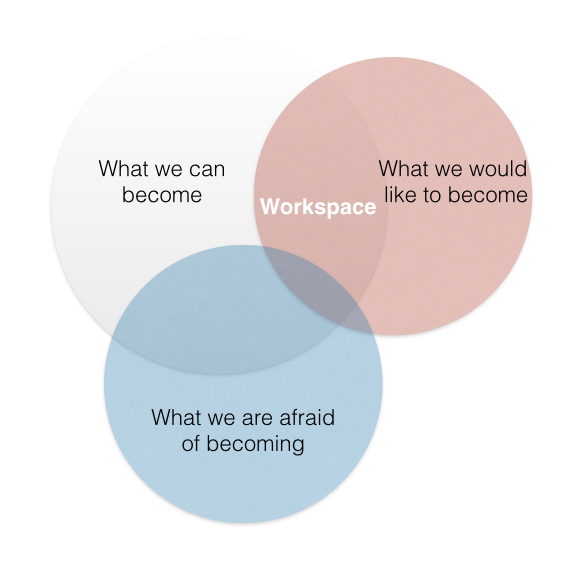
We are used to basing our self-concept on what we are now. When we shift our attention toward the future, an ever wider range of possibilities opens up. This allows us to map out paths of study, work and personal growth that aim at the goal we have set ourselves. This image also lets us overcome some of the rigidity in our behavior. We try to adopt behaviors that bring us closer to our positive images and avoid those that push us toward negative ones. The further ahead we look, the more opportunities and paths are open to us.
- What we might become. Experiences, culture, the groups we belong to and our (current) self-image strongly affect what we believe we can do. Defining the field of possibilities is very hard because we are unable to be objective in assessing ourselves. This is in fact the point on which to be most rigorous and realistic. Counseling and coaching are paths in which an outside consultant can help us sharpen the boundaries of our possibilities.
- What we would like to become. Here the hardest part is examining our desires without hiding them. On this point we should rule nothing out and set ourselves no limits.
- What we are afraid of becoming. These are directions we could take, but they can often be avoided by planning a path and not letting ourselves be carried along by daily life.
From here the path continues in three steps:
- Defining our goal. After looking at all the possibilities and how desirable or undesirable they are, we reach the point where we have to make a decision. Stalling at this point only narrows our range of choices.
- Defining the strategies. Imagining what is possible for one’s future can increase optimism. But it is not always enough to generate the effort needed to produce a change in behavior. In a study of 160 American eighth graders from low-income families, followed over the course of a school year, improvement in grades and in time spent on homework was associated with academic possible selves linked to concrete strategies for attaining them (Oyserman, Bybee, Terry and Hart-Johnson, 2004). This is why we need to define specific strategies (concrete behaviors such as studying, setting alarms to force ourselves to do what we decided, lists, assessments with rewards) that help us focus on our goals.
- Monitoring. The image we have set as our goal must always be present. As time passes our room for maneuver steadily shrinks, so we need to check our course and keep making corrections.
The study of the implications of possible selves can be applied to fields as varied as school counseling (https://scholarworks.umass.edu/entities/publication/1936199e-97a2-4c6c-809e-8c3332a3c2db), juvenile delinquency (https://pubmed.ncbi.nlm.nih.gov/2213484), career decisions and personal paths.
In the area of careers in particular, “who I want to be” is at the center of what matters. Self-development is personal, and the process changes people’s outlook in a lasting way. For this reason, using possible selves increases the likelihood that the path will succeed. This method emphasizes goals rather than problems, which fosters motivation and satisfaction.
(Alberto Viotto)