The sales process and rationality in decisions: prospect theory
Reference points, probability weighting, and the value function: the model that describes how customers actually choose, applied to the sales process.
by Alberto Viotto · Published · Updated
In the post “Loss aversion in salespeople: do we play to win or not to lose?” I touch on loss aversion in behavioral economics. The subject deserves a closer look, because it applies to many situations inside a company. In sales, more than elsewhere, its relevance is obvious: the question we ask ourselves when a customer is about to decide is whether or not to expect a rational decision.
In 1979 Kahneman and Tversky set out a model for understanding people’s actual choices and their rationality: prospect theory (https://doi.org/10.2307/1914185). The results of that study were replicated, in a paper published in 2020, with 4,098 people in 19 countries: although some effects were attenuated, the authors conclude that the empirical foundations of the theory hold (Ruggeri and colleagues, 2020).
According to this theory, people make decisions by weighing potential losses and gains rather than by seeking optimal decisions. A prospect is the combination of all the possible outcomes of an alternative and the probabilities attached to them.
Prospect theory distinguishes two phases in the choice process:
Editing
This is a preliminary analysis of the alternatives that yields a simplified view of the available prospects, ordering them by hypothetical gains and losses. The analysis is carried out largely unconsciously and with many simplifications.
In practice, a reference point is set (the situation at the time of the decision, or a benchmark to be reached); all the possible alternatives are considered in terms of gain or loss relative to it (outcomes worse than the reference are losses, and better outcomes are gains). Because of limits on time, knowledge, and processing capacity, these values are approximations, so when people are unable to apply precise algorithms they fall back on heuristics (approximation techniques we use to make assessments or decisions quickly or from incomplete data – https://en.wikipedia.org/wiki/Heuristic). Outcomes regarded as equivalent are combined to simplify the next phase. On heuristics, the classic reference is Tversky and Kahneman (1974): they are highly economical and usually effective, but they lead to systematic and predictable errors.
Evaluation
The simplified versions of the prospects that emerge from the editing phase are evaluated, and the prospect with the highest value is chosen.
Two functions are used in this phase:
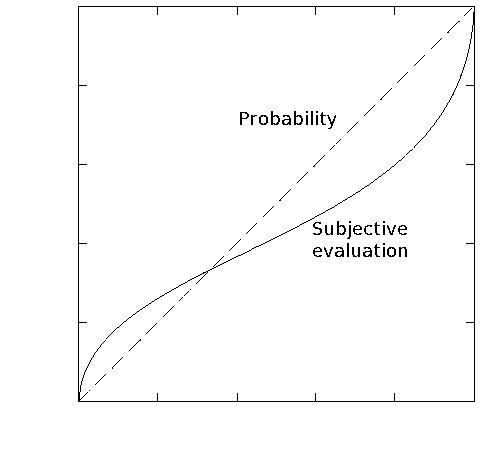
- Probability weighting: people tend to overreact to events with small probabilities, but they react less to large probabilities. This means that unlikely outcomes are overweighted relative to the certainty of not obtaining them, and very likely outcomes are underweighted relative to the certainty of obtaining them.
- Value function: this is defined over changes in benefit relative to the reference point. It is steeper in the domain of losses than in that of gains (more effort goes into escaping losses than into pursuing gains).
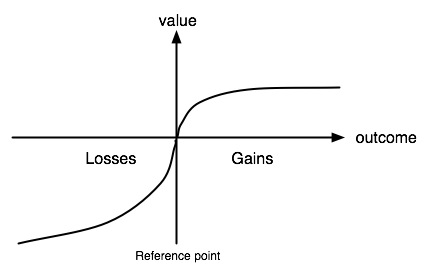
Escaping pain and seeking pleasure are two roads traveled at different speeds. But this theory is not only about loss aversion:
- The starting point is what we base all subsequent evaluations on, so it has a very strong effect on the outcome of the choice. The context (framing) also includes the problem itself; formulating the problem in different ways can lead to opposite decisions. This is the result of the celebrated work on framing (Tversky and Kahneman, 1981): the same problem, presented in different ways, produces predictable shifts of preference, up to and including their reversal.
- The isolation effect concerns the breaking down of alternatives into their salient elements in order to simplify the analysis. We then concentrate on some parts only and leave out the others, and we skew the result by not considering the alternatives as a whole.
Applied to the sales process, the main points of this theory can be seen as follows:
- Setting the starting point: this phase is often underestimated by people who work in sales. It is important to bear in mind that, in the evaluation phase, the distance between the starting point set by the customer and the one assumed by the salesperson is amplified. Heuristics play a significant part in setting the reference point and are hard to predict.
- Isolation effect: this identifies the elements on which the customer will base the final decision. Once it has been settled what is salient, the rest is treated as a detail.
- Probability weighting: the tendency to overreact to small probabilities, while reacting less to large ones, makes the evaluation less linear. The value of details is therefore amplified, and this has to be taken into account.
- Value function: as noted above, this reflects the greater effort put into escaping losses than into pursuing gains. So it is unwise to think we can play down the risks of a deal when talking with a customer, because a good part of the final evaluation will be based on those very points.
(Alberto Viotto)