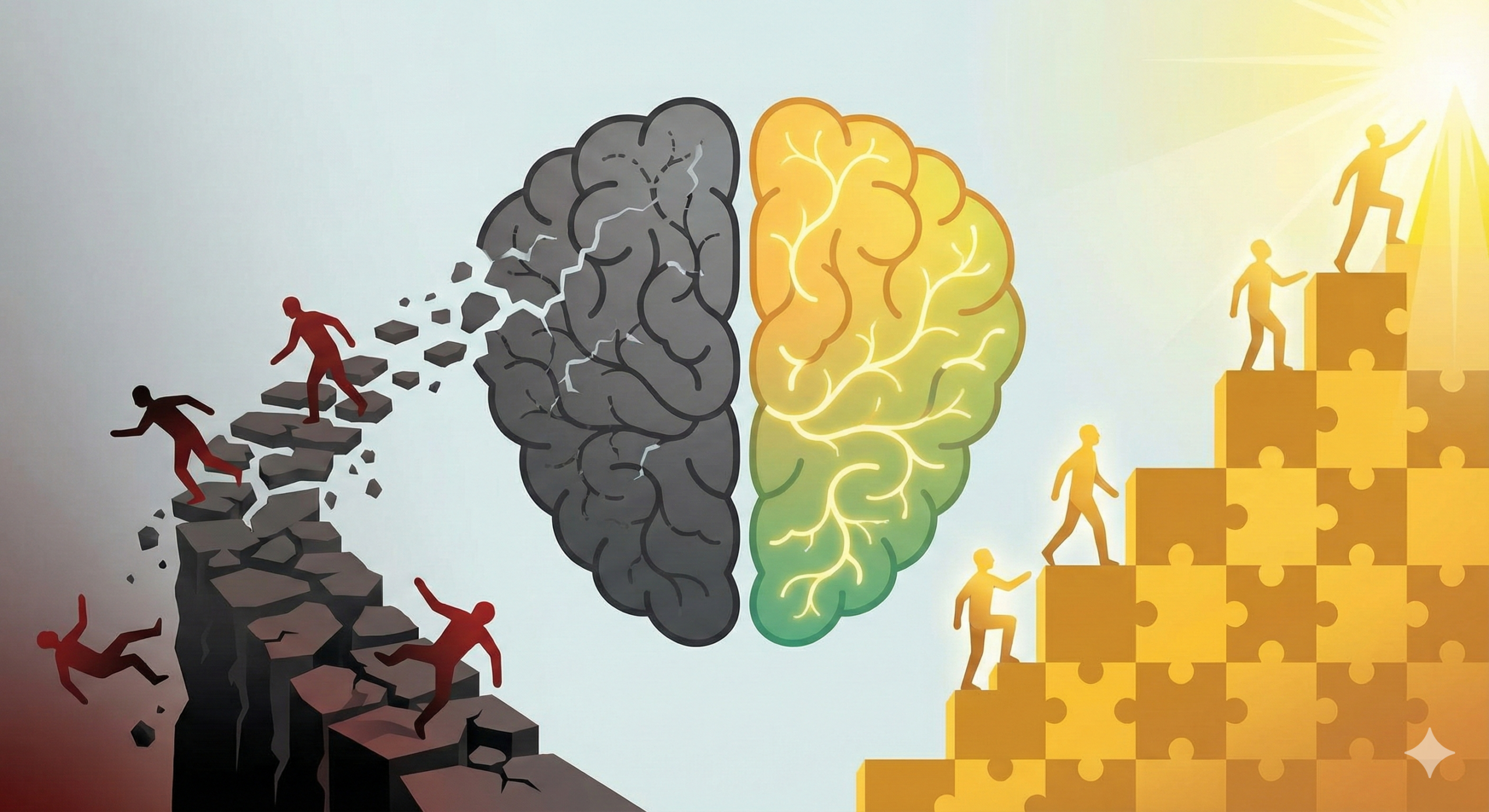
Ethical erosion and moral strength in the workplace
Neuroscience explains why small transgressions at work turn into habit, and how the brain supports and rewards honest choices.
by Alberto Viotto · Published · Updated
In business, a breach of integrity rarely shows up as an isolated or sudden event. It tends instead to emerge through a gradual process, a “slippery slope” along which ethical judgment progressively deteriorates. The last fifteen years of research in neuroscience and behavioral psychology offer crucial tools for understanding both the dynamics of moral decline and the neural mechanisms that sustain virtue and the courage to decide within organizations.
The neurobiology of habituation to wrongdoing
The human brain does not delegate ethical decisions to a single circuit; it processes choices through a complex network that balances instinct, fear and logic. Faced with a first ethical violation, the natural reaction is often visceral: studies show that thinking about an immoral act activates brain areas linked to physical disgust, such as the anterior insula, suggesting a deep connection between sensory and moral revulsion. In a Swiss study, for example, reflecting on moral dilemmas heightened the physiological and neural response to a subsequent disgusting odor, but not to pain (Sharvit, Lin, Vuilleumier and Corradi-Dell’Acqua, Science Advances, 2020).
Repeating the wrongful act, however, triggers a dangerous mechanism of neural adaptation. Research conducted at University College London (Garrett, Lazzaro, Ariely and Sharot, Nature Neuroscience, 2016) showed that repeated lying progressively reduces the activation of the amygdala, the structure responsible for processing the negative emotional response. In essence, the more a person lies, the less the brain reacts emotionally, making ever larger lies easier without the brake of stress or guilt.
The phenomenon is borne out at the behavioral level as well. An experiment published in 2015 in the Journal of Applied Psychology (Welsh, Ordóñez, Snyder and Christian) showed that the propensity to cheat for money doubles when the opportunities to take resources increase gradually, compared with scenarios that present the chance of a single large fraud. A small initial transgression paves the way, allowing the person to rationalize their own behavior and normalize the violations that follow.
Stress, risk and the “lesser evil” trap
In the workplace, pressure for results often acts as a catalyst for unethical behavior. Under intense stress the body releases hormones such as cortisol, which can interfere with higher cognitive functions and reduce the ability to weigh moral implications clearly.
Risk tolerance, moreover, can distort decision-making. A study published in 2024 by Indian researchers (Sahai and Manjaly, Frontiers in Behavioral Economics) found that people who have just been exposed to risky choices (such as gambles) are more likely to replace absolute moral rules with purely utilitarian cost-benefit calculations when they face a moral dilemma.
Professionals often find themselves trapped in dilemmas perceived as “the lesser evil.” Research from the University of Leuven showed that choosing between two negative options takes longer and generates more fear than situations that offer at least one positive way out. The study is Claes, Crombez, Meulders and Vlaeyen (The Journal of Pain, 2016); the experiment concerned the choice between movements associated with pain, not ethical dilemmas. In such moments the risk is that wrongful acts get redefined as necessary (falsifying data to protect business continuity, for example), inhibiting the search for alternative solutions that are morally sound.
Training ethical resilience: the plasticity of courage
Fortunately, neuroplasticity works in both directions: just as we adapt to vice, we can strengthen virtue. The brain changes in response to repeated behavior, which implies that acts of moral courage, if practiced, gradually become more natural.
A study conducted in Israel (Nili, Goldberg, Weizman and Dudai, Neuron, 2010) illustrated this mechanism through the handling of fear. Participants asked to bring a feared object (a snake) physically closer to themselves showed specific activation of the subgenual anterior cingulate cortex, an area linked to emotional regulation, which acted by suppressing the activity of the amygdala. Carried over to the business context, this suggests that overcoming the initial fear of acting ethically (reporting an irregularity, for example) reinforces the neural circuits that make such actions easier in the future, consolidating the individual’s moral robustness.
Organizational strategies for integrity
Companies can implement strategies based on this scientific evidence to promote a culture of integrity:
- Mindfulness and objective detachment: A 2023 Chinese study (Du, Yu, Liu and Zhou, Scientific Reports) found that eight weeks of mindfulness training reduces the propensity to harm others for personal gain. The practice fosters a more objective perspective and tempers the automatic pursuit of profit at any cost.
- Ethical leadership and social contagion: The behavior of those at the top has a direct impact on the people who work for them. Research from Maastricht University (Manara, van Gils, Nübold and Zijlstra, Frontiers in Psychology, 2020) confirmed that the presence of ethical leadership significantly reduces acts of corruption among subordinates. Integrity is socially contagious: environments that openly support honesty and loyalty encourage transparency and inhibit violations.
- The heroic imagination: It is essential to cultivate the ability to picture one’s own actions in critical scenarios. A meta-analysis from the University of Sheffield shows that forming strong intentions in advance about how to behave increases the likelihood of acting accordingly under pressure. Exercising what Zeno Franco and Philip Zimbardo have called the “heroic imagination” makes it possible to anticipate ethical challenges mentally and prepare to handle them firmly.
Conclusion: the aesthetics of rectitude
Neuroscience reveals that moral decline and moral growth run on parallel neural tracks, exploiting the same mechanisms of habit and reward. It is telling that the same brain region — the medial orbitofrontal cortex — is involved both in evaluating the morality of an action and in appreciating aesthetic beauty. In one study, the activity of this area increased both with judgments of facial attractiveness and with judgments of moral goodness (Tsukiura and Cabeza, Social Cognitive and Affective Neuroscience, 2011). Acting with rectitude, then, is not only an ethical imperative but a source of intrinsic reward, capable of generating a deep sense of professional and personal meaning.
Alberto Viotto (culturainimpresa.com)