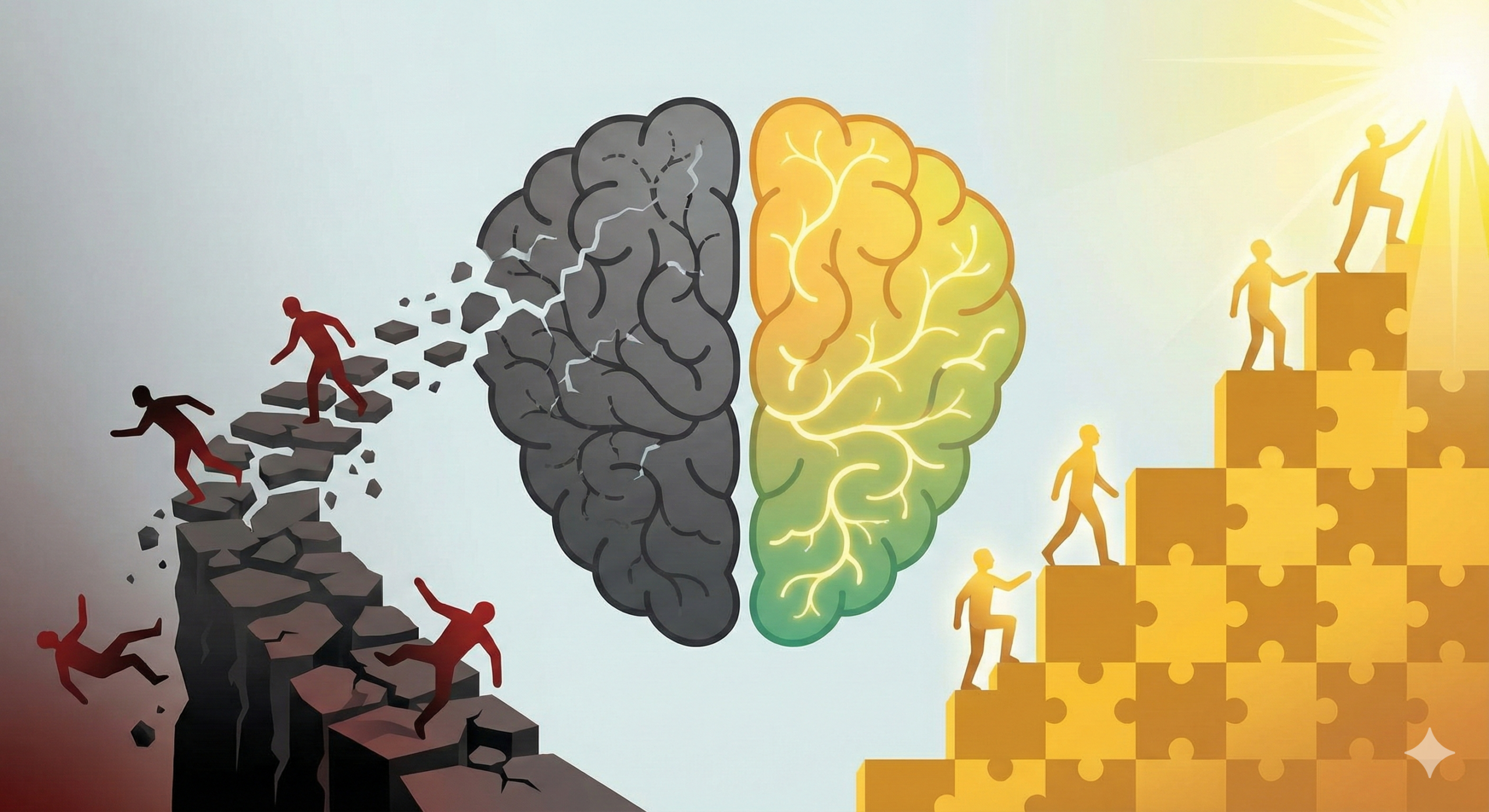
Ethical erosion and moral strength in the workplace
Neuroscience explains why small transgressions at work turn into habit, and how the brain supports and rewards honest choices.
Social psychology explains much workplace behavior that looks irrational. Cognitive biases, errors of judgment, and group dynamics, with the studies that document them.
Neuroscience explains why small transgressions at work turn into habit, and how the brain supports and rewards honest choices.

From Weick onward, research describes workplace communication as the process through which an organization builds meaning, identity, trust and power.

A century of experiments, from Allport to Zajonc, shows which tasks benefit from the presence of other people and which ones suffer.
Ability differences between boys and girls are minimal, yet the expectations of teachers, families and employers shape their study and career choices.
Five traits business owners should keep an eye on, because a negative environment hurts employees, customers and results in often indirect ways.
Workplace bullying harms people's health and the company's results; research points to the organizational and individual factors worth acting on.

From Breazeal's social robots to today's assistants, machines are learning to read emotions, a step forward that raises questions of authenticity and privacy.

Seen through sociology, artificial intelligence grows out of existing social relations and tends to reproduce their injustices unless it is deliberately steered.

The need for esteem and our defense mechanisms explain why, with colleagues and staff, recognition gets more lasting results than reprimand.

From Festinger's definition to the risks of groupthink, the factors that hold a team together and practical techniques for strengthening its cohesion.

Heuristics save mental effort but skew our judgments of people: where this error comes from and how to reduce its weight in our assessments.

Written in February 2021, mid-pandemic, it describes the collective emotions of people at work and the support companies were called on to give.
People who are uncertain or face too many alternatives prefer to wait, even at a price: two classic experiments and what they mean for sellers.
Reference points, probability weighting, and the value function: the model that describes how customers actually choose, applied to the sales process.
We judge coworkers we barely know by their behavior and overlook their role, until a partial picture hardens into a lasting one.
The more people notice a problem, the less likely anyone is to act: ambiguity and diffused responsibility hold back change inside organizations.
Job satisfaction and dissatisfaction are not opposite ends of one scale, and that changes what managers should do first to motivate their people.
People who feel in control of events respond to praise and rewards differently from those who credit luck, which matters before you try to motivate.
Ask customers what they want and you get a faster horse: what research says about the limits of letting customer requests drive product development.
There is always a gap between what we mean and what the listener understands; eight elements help narrow it with people from other cultures.
Starting from who we want to become, rather than from the next deadline, makes goals more coherent and ambitious: the possible selves approach.
Work provides time structure, social contact, purpose, identity, and activity; losing these latent functions costs more than economic indicators show.
Rational model, bounded rationality, garbage can, Vroom-Yetton: how individuals and groups actually decide, and which biases pull them off course.
Context, familiarity, and expectations shape judgment before reasoning starts: how impressions form and when an argument can actually change them.
Only 11% of Italian employees say they are engaged: motivation theories show where to act before turning to training courses and incentives.

From Allport to Zajonc, a century of social facilitation research shows when working together pays off and why brainstorming groups so often disappoint.