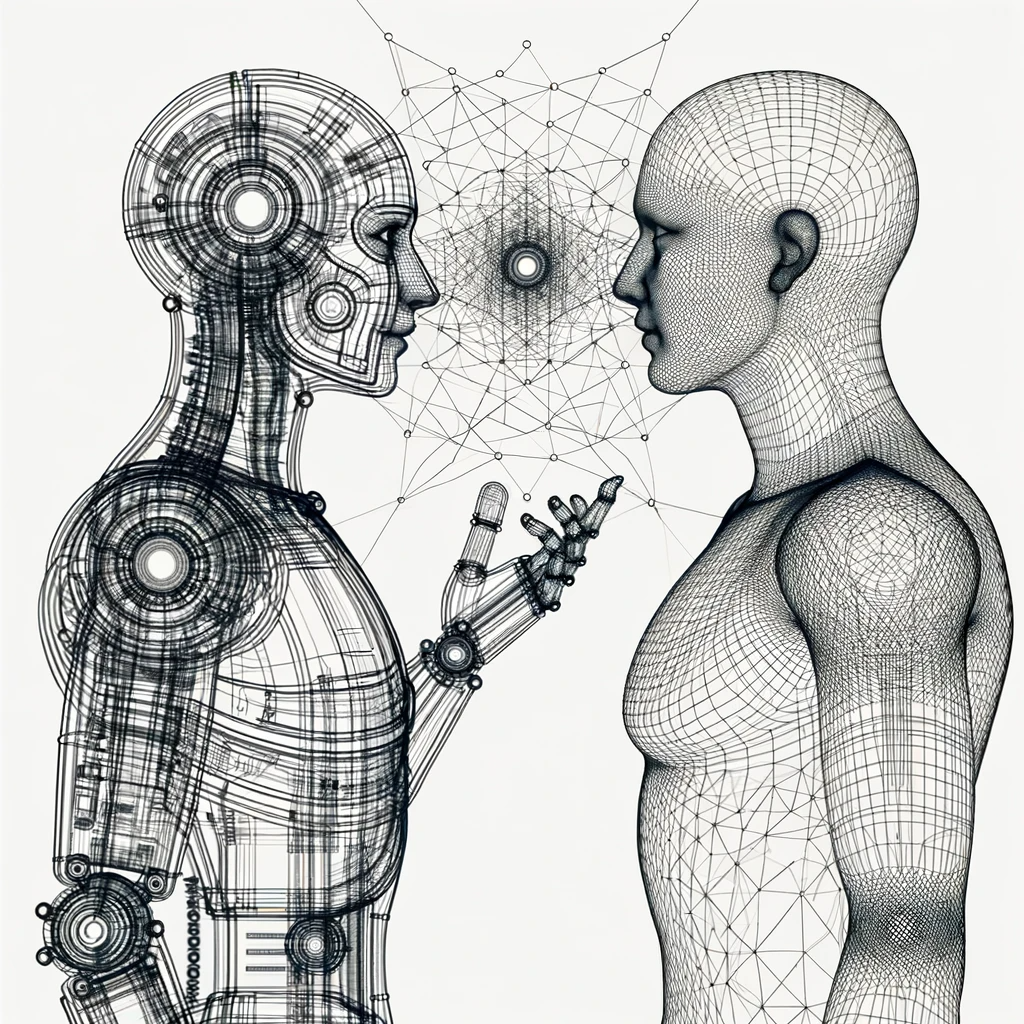
Artificial intelligence and empathy: toward a new paradigm in human-machine interaction
From Breazeal's social robots to today's assistants, machines are learning to read emotions, a step forward that raises questions of authenticity and privacy.
by Alberto Viotto · Published · Updated
The intersection of artificial intelligence and empathy is an area of growing interest in technology research. AI, traditionally centered on logic and rationality, is now exploring the frontier of emotional intelligence, a territory once considered exclusive to human experience.
The concept of “artificial empathy,” discussed in depth by Andrew McStay in “Emotional AI: The Rise of Empathic Media” (2018), refers to the novel ability of artificial intelligence systems not only to recognize and interpret human emotions, but also to respond to them in an appropriate and sensitive way. The idea rests on the premise that AI systems can be programmed or trained to understand and react to the various shades of human emotion, offering users a more natural and engaging interaction.
This perspective has its roots in the research carried out by Cynthia Breazeal in the early 2000s. The year 2003 saw, for example, the article “Emotion and sociable humanoid robots,” published by Breazeal in the International Journal of Human-Computer Studies. Breazeal, a pioneer in the field of social robotics, has explored in depth the role of social robots in imitating and taking part in human interactions. Her work has focused in particular on the importance of giving robots “empathic” capabilities, showing how integrating such features can markedly improve their effectiveness in communication. Breazeal’s studies have shown that robots able to express and interpret emotions can establish deeper connections with human beings, making for more meaningful and natural interactions.
These concepts are especially relevant across a wide range of applications, from health care to training, from customer service to entertainment. In health care, for example, empathic robots can provide patients with support and companionship, while in education they can adapt their teaching methods to students’ emotional responses. In customer service, moreover, the ability to recognize and react to the customer’s emotions can lead to a more satisfying user experience.
In the broader context of artificial intelligence, the concept of artificial empathy also raises important ethical and philosophical questions. While the deployment of these technologies promises to improve interaction between humans and machines, the question arises of how these “empathic” AI systems affect our understanding of human empathy and of the relationship between real and simulated emotions. Questions also arise about privacy and data security, since detecting and interpreting emotions requires access to sensitive personal information. In the European Union, the Artificial Intelligence Act (Regulation (EU) 2024/1689) has prohibited, since February 2, 2025, emotion recognition systems in workplaces and educational institutions.
Progress in artificial intelligence, especially when it comes to creating illusions of understanding and emotional connection, raises significant ethical questions, as Sherry Turkle’s book “Alone Together” (2011) makes clear. Turkle, a renowned author and scholar of human-computer interaction, highlights concerns about the authenticity of interactions between humans and machines, calling into question the impact of these interactions on the very nature of human relationships.
In her work, Turkle explores the concept of AI as a simulator of empathy, questioning the depth and truthfulness of the “relationships” people can develop with machines. Her main concern is that AI, although able to imitate human emotional responses, lacks any real emotional understanding, which could give users a false sense of connection and of being understood. This raises questions about the effect such interactions may have on the emotional and social development of individuals, especially the youngest or those who might come to depend heavily on these technologies for emotional support.
Turkle also examines how interacting with AI systems that simulate empathy could alter the way humans perceive interpersonal relationships. There is a risk that people may come to prefer interactions with machines, perceived as less complicated and more controllable, to the complex dynamics of human relationships. This scenario calls into question emotional resilience and maturity in human relationships, especially when people might start avoiding the conflicts and challenges that are in fact an intrinsic part of human interaction.
Another ethical issue concerns privacy and the use of personal data. AI that imitates empathy needs access to large quantities of personal data to be effective. This raises concerns about how such data are collected, processed, and protected, especially given the vulnerability of users who might share intimate or sensitive information with these machines.
Finally, Turkle questions the ethics of replacing human interactions with interactions with machines. While AI can offer comfort and support, there is a risk that its presence may displace the valuable experiences of growth, learning, and emotional connection that come from human relationships. This raises fundamental questions about the value society places on the authenticity of human relationships and about the role technology should play in meeting people’s emotional needs.
There are, however, not only risks but also opportunities:
A research team at the University of Washington studied how artificial intelligence could help people on TalkLife, a platform where users give one another mental health support (Sharma and colleagues, Nature Machine Intelligence, 2023: 300 TalkLife volunteers; responses written with the system’s help were 19.6% more empathic on average). The researchers developed an artificial intelligence system that suggested changes to participants’ responses to make them more empathic. The system helped people communicate empathy more effectively than those who responded without assistance. The best responses came from collaboration between AI and people.
TalkLife was chosen for the study because peer support platforms can have a significant impact on mental health, addressing the problem of access caused by insurance issues, stigma, or isolation. TalkLife is the largest peer support platform in the world and has a large number of motivated peer supporters.
The goal of helping people communicate more empathically rests on the fact that empathy is essential to making people feel supported and to building relationships of trust. Yet empathy is complex and nuanced, and it is often hard to find the right words at the right moment.
AI can be useful here because it can offer specific, contextual suggestions for replying to a message in a way that is concrete, personalized, and unobtrusive. Over the course of the study, users did not become overly dependent on the AI; they used its suggestions as a source of inspiration rather than following them blindly. In the subgroup of those who said they had difficulty offering support, the increase in empathy was more pronounced: 38.9% (Sharma and colleagues, 2023).
The results of the study show that the use of AI led to a significant increase in empathy in users’ responses, without making them dependent on the AI. This study suggests that collaboration between human beings and artificial intelligence systems can produce positive results, especially in complex, open-ended tasks such as empathic conversations.
Empathic AI may have revolutionary applications, from mental health to customer service, offering innovative tools for tackling complex problems. Still, we must not overlook the ethical and social implications of these technologies. The challenge is not only technological but also philosophical: we need to define how far the empathy simulated by machines can be considered authentic and what impact it will have on society.
It is therefore important that research and development in this area proceed with a critical awareness of the possible consequences. A multidisciplinary approach, combining technological expertise with psychological, ethical, and social insight, will be essential to guiding the evolution of empathic AI in a responsible and beneficial way.
Integrating empathy into artificial intelligence is not only a technological advance but also a step toward a deeper understanding of the complexity of our emotions and of our humanity. As we continue to explore this uncharted territory, we must remain watchful guardians of the values that define our humanity, making sure that the technology we develop enriches, rather than diminishes, the quality of our human interactions.
(Alberto Viotto)