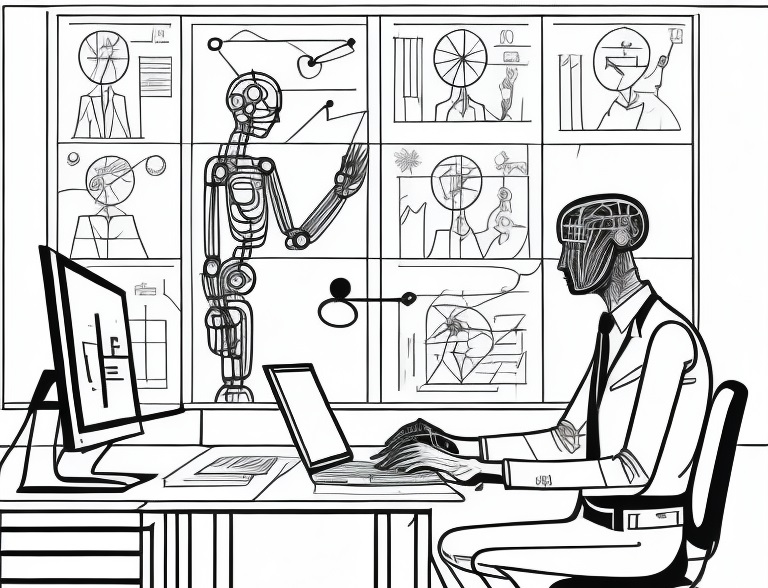
AI versus humans?
A review of what automation puts at risk for workers, with McKinsey and World Economic Forum estimates of the jobs that will change by 2030.
by Alberto Viotto · Published · Updated
Artificial intelligence and the risks in the labor market
The growing use of tools based on artificial intelligence, and of other technologies that automate work across many sectors, worries workers, economists and policymakers alike. The growth can be measured: according to Eurostat, in 2025, 19.95% of European Union enterprises with at least ten employees used artificial intelligence technologies, 6.47 percentage points more than in 2024. Automation has underpinned economic growth for decades, but the pace of technological progress in recent years has made forecasts about the future of the labor market more uncertain. In this article I will concentrate mainly on some of the risks.
One of the most significant risks of automation is the potential displacement of work toward automated systems.
A 2017 report by the McKinsey Global Institute, titled “Jobs lost, jobs gained: What the future of work will mean for jobs, skills, and wages,” examined the potential impact of automation and artificial intelligence on the global labor market. The report estimates that as many as 375 million workers may need to change occupations or acquire new skills by 2030 because of these new technologies. More recent estimates (World Economic Forum, Future of Jobs Report 2025) project that by 2030, 92 million jobs will disappear and 170 million new ones will be created, with 59 out of every 100 workers needing to retrain.
As more and more companies turn to artificial intelligence and robotics to replace human workers, many jobs are becoming obsolete. Manufacturing companies were the first to experiment with new technologies to raise productivity; by now robots and numerically controlled machines have sharply reduced the number of human beings required, particularly in mass production. The development of technologies based on artificial intelligence will make it possible to use them in less repetitive areas of production as well, where the human worker has so far remained very important. But automation is not confined to manufacturing, and its effects are increasingly visible in many other sectors, such as transportation, finance, healthcare and customer service.
The displacement of jobs caused by automation can have significant economic and social consequences. In the long run, this scenario may lead to unemployment, lower pay and less job security. Obviously, job losses can have a domino effect across the whole economy, since a reduction in workers’ spending power also means lower demand for goods and services and, potentially, a slowdown of the global economy.
Automation therefore affects industries and job roles differently, and this can translate into an uneven distribution of the negative effects, pushing some categories of workers to accept lower wages and increasing social inequality.
A 2020 study by Statistics Canada (Frenette and Frank, “Automation and Job Transformation in Canada: Who’s at Risk?”) examined the potential impact of automation on the Canadian labor market. The study found that those most at risk are workers with low education and low income, part-time workers, the oldest (55 and over) and the youngest (18 to 24).
Policymakers and business leaders must take steps to mitigate the negative effects, such as investing in education and training programs to help workers acquire the skills required by a changing labor market, implementing policies to support workers who have been replaced by automation, and exploring ways to promote job creation in the industries that are less exposed to the impact of the new technologies.
It is important to note, however, that not all jobs are equally vulnerable to automation: jobs that require emotional intelligence, direct contact with people and non-repetitive manual skill are harder to automate than those that involve repetitive tasks; creative and cognitive jobs, on the other hand, are now within reach of generative AI. Automation can also create new job opportunities in areas such as the development of new systems, data analysis and machine maintenance. To take advantage of these opportunities, workers must acquire the skills that the changing labor market requires.
Education and training are essential to equip workers with the necessary skills, and these are not only technical skills but also the so-called “soft skills,” such as creativity, critical thinking and the ability to relate to others. This may require investing in education and vocational training programs, offering on-the-job training opportunities, and collaborating with universities and other educational institutions.
It will also be necessary to work together to create a policy environment that favors innovation and entrepreneurship. This may include providing tax incentives and regulatory support for startups and small businesses that are developing artificial intelligence and new technologies, creating a supportive ecosystem for innovation, so as to ensure that the benefits of artificial intelligence and automation are shared and contribute to overall economic growth.
Artificial intelligence systems can also replicate and exacerbate human biases and errors, such as discrimination based on gender, ethnicity and sexual orientation. This is a risk for diversity and fairness in the labor market.
Some studies have shown how human biases and errors can be unwittingly absorbed into artificial intelligence systems through data and algorithms. For example, if a data set used to train an artificial intelligence system is unbalanced (even if it reflects reality), the system may replicate that imbalance, producing a bias. Caliskan, Bryson and Narayanan (2017) showed this in Science: a machine learning system trained on ordinary human language absorbs its biases. This can lead to discriminatory effects in activities such as hiring, promotions and performance reviews.
In addition, the lack of diversity in the technology sector can in itself contribute to bias in artificial intelligence systems. The imbalance is in the numbers: in 2025 women made up 19.5% of the information technology specialists employed in the European Union, men 80.5% (Eurostat). If the teams that develop artificial intelligence products were too homogeneous, they could build biases and errors into the systems they create.
It therefore becomes essential to establish rules and standards to ensure that artificial intelligence systems are developed and used fairly and ethically. This may include implementing audits and process certification to ensure that artificial intelligence systems comply with shared standards. In the European Union this has happened with the Artificial Intelligence Act (Regulation (EU) 2024/1689, in force since August 1, 2024), which classifies as high-risk the systems used for recruiting and managing personnel; the obligations for these systems apply from December 2, 2027.
Another issue to consider is the potential risk to personal privacy and data protection. This is particularly relevant in the context of hiring and firing, where artificial intelligence systems can collect and analyze large amounts of personal information about candidates and employees. AI systems could gather personal data from a variety of sources, including social media profiles, online behavior and biometric data. These data could then be used to make assessments, potentially without the knowledge or consent of the people involved.
To address these risks, it is important to give priority to privacy and data protection in the development and use of artificial intelligence systems in the labor market. This may include implementing measures to ensure that personal data are collected, used and stored securely and transparently.
(Alberto Viotto)