What is the hidden cost of unemployment?
Work provides time structure, social contact, purpose, identity, and activity; losing these latent functions costs more than economic indicators show.
by Alberto Viotto · Published · Updated
In periods of crisis, rising unemployment is a phenomenon that is often discussed. But only the economic effects of joblessness on individuals are taken into account.
Is the problem purely economic, or are there other implications that we are avoiding looking at?
Jahoda’s latent deprivation model suggests that employment has positive psychological effects on the individual and that its absence causes negative effects on several fronts.
People look for work out of the need to earn and to provide for their needs. This is the manifest function of work, but five latent functions come with it as well:
- Time structure: our time (like anything else) is worth more when it is scarce. The imposition of a stable time commitment allows us to organize our day, giving us a sense of security and making our free time more valuable.
- Social contact: it widens our chances of having relationships that go beyond the small number of people reachable through our closest contacts.
- Collective purpose: it lets us give meaning to our actions through shared aims.
- Social identity (status): it gives us a social status that helps sustain our personal identity, regardless of how important the job is.
- Regular activity: regular, regulated and frequent activity keeps us active, gives security and helps develop skills and self-efficacy.
The negative effects are measurable in the most serious cases: according to Brenner’s estimates, every 10% increase in unemployment is associated with:
- A 1.2% increase in total mortality
- A 1.7% increase in mortality from cardiovascular problems
- A 1.7% increase in the number of suicides
There are also notable increases in violent crime and in mental health problems.
M. Harvey Brenner, “Influence of the Social Environment on Psychology: The Historical Perspective,” in Stress and Mental Disorder, ed. James E. Barrett (NY: Raven Press, 1979)
On mortality, a meta-analysis of 42 studies, with data on more than 20 million people, estimated that the unemployed face a 63% higher risk of death than the employed, after adjusting for age and other variables (Roelfs and colleagues, 2011); the association is weaker in studies that account for health-related behaviors.
These percentages are also linked to the age of the individuals, rising significantly among those over 50. The correlation between suicides and unemployment in this age group is particularly evident in the UK data from the ONS (Office for National Statistics):
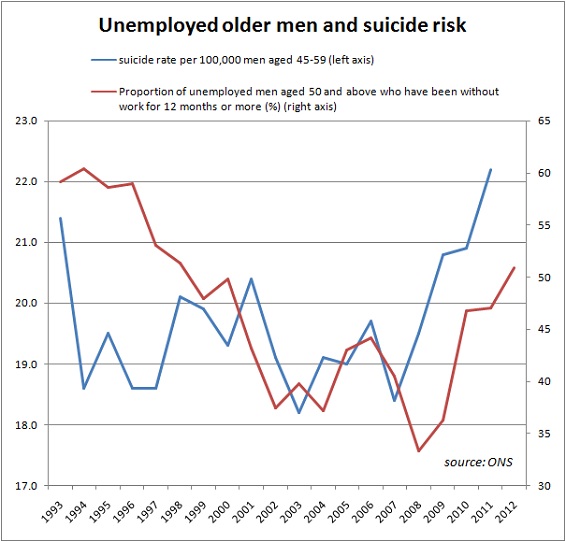
What is not easily measurable is the level of distress among all the unemployed. An overall estimate comes from a meta-analysis of 237 cross-sectional and 87 longitudinal studies: among the unemployed, people with psychological problems average 34%, compared with 16% among the employed (Paul and Moser, 2009).
Employment is the only activity in modern societies able to provide all five latent functions to a sufficient degree. Participation in religious groups, volunteering and the like provides these functions only in part and not in a stable way. Substitute activities therefore have a limited impact on reducing the distress of the unemployed.
The social impact of the economic crisis is therefore deeper than the economic indicators might suggest, and these hidden costs ought to be taken into account.
(Alberto Viotto)