Artificial intelligence and business management software
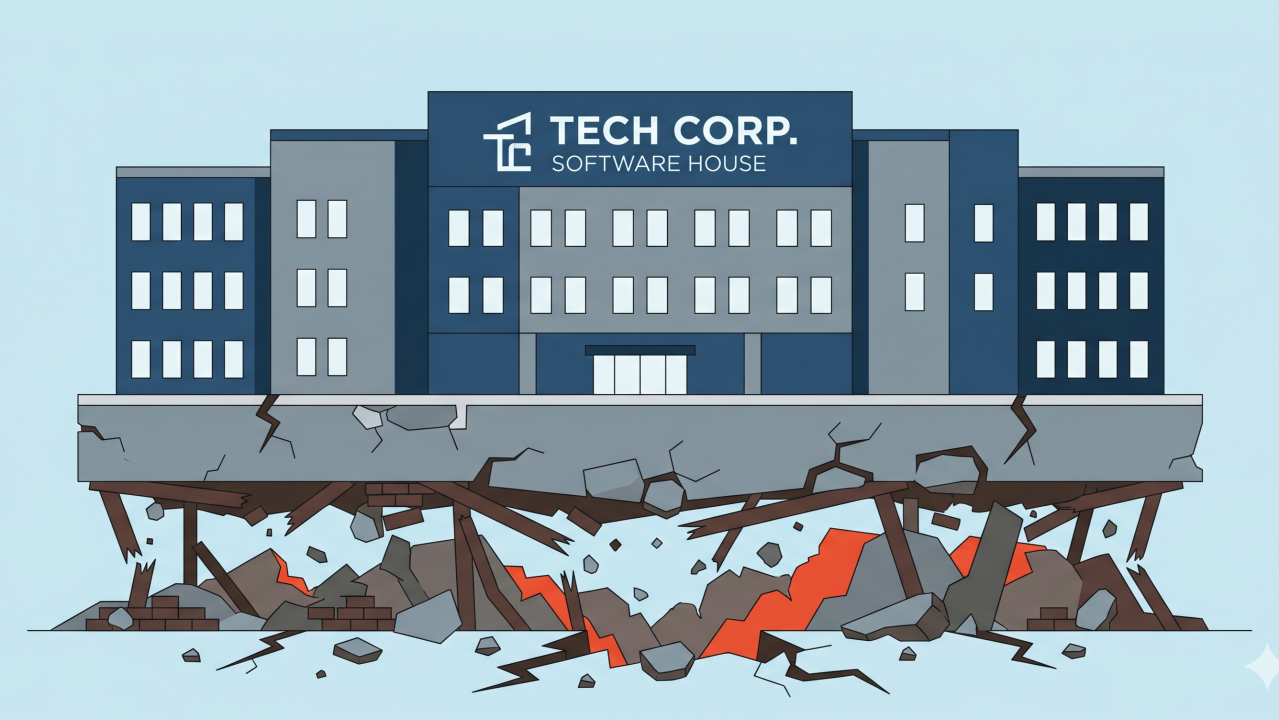
Software companies built before 2022 face a choice about business model, cost structure and pricing, not merely about which technology to adopt.
by Alberto Viotto · Published · Updated
Why Italian software is facing a transformation that cannot be solved by adding artificial intelligence to business management software
There is an asymmetry between the software houses that are growing within the artificial intelligence transition and those that are merely undergoing it, and it is worth naming for what it is. It is not a difference in technical competence, nor, strictly speaking, in speed. It is a difference in cost structure and in the way value is captured from the customer. A difference that, taken seriously, should keep awake at night anyone who today runs a software company built before 2022.
To give a sense of scale: Anysphere, the American company that makes the code editor Cursor, went from one hundred million dollars in annualized revenue in January 2025 to two billion in February 2026, with a headcount estimated at between fifty and three hundred people (in August 2026 the company was acquired by SpaceX). Harvey, in legaltech, reached one hundred ninety million in ARR in three years with a few hundred employees. These are numbers that, in any earlier chapter of software history, would have been simply impossible. Underneath them is a different economic structure: bottom-up distribution with no sales force, purely variable cloud infrastructure, small teams in which every professional is amplified by generative tools, and above all a pricing model that does not sell seats (the per-seat license presupposes a human being in front of the screen) but outcomes, consumption, value generated. It is the structure, not the product itself, that is asymmetric with respect to that of traditional software companies.
And in Italy?
At this point it is worth lowering our gaze from the international landscape to our own. According to the report Il Digitale in Italia 2025 by Anitec-Assinform and NetConsulting cube, the Italian digital market reached eighty-one point six billion euros in 2024, and the artificial intelligence market was worth nine hundred thirty-five million in 2024, with a forecast of one billion two hundred forty million for 2025. Positive numbers, and rightly emphasized at industry conferences.
Beneath these numbers, however, is a structure that deserves an honest look. The fabric of Italian software is divided, to put it bluntly, into two worlds that are both exposed to the change, but in different ways. On one side is the long tail of micro-enterprises: according to the Osservatori Digital Innovation of the Politecnico di Milano, in 2023 the sector counted more than twenty-six thousand companies, eighty-three percent of them with fewer than ten employees. It is a fabric vastly more fragmented than the German or the French one, built historically on business management software and customizations for local SMEs, founded on proximity to the customer, on multi-year support contracts, on accumulated knowledge of each individual customer’s specific process. On the other side are the large national groups, which over the past fifteen years have built their growth on a strategy of aggressive consolidation: acquire the local micro-enterprises, integrate them into their portfolio, build critical mass.
The two structures have different problems, but both are exposed.
The micro-enterprise and the illusion of enrichment
The eight-person micro-enterprise that lives on support contracts with fifty or a hundred customers does not have the structure to face a new entrant (Italian or foreign) that offers the customer an equivalent system at a tenth of the price, delivered in two weeks instead of two years. AssoSoftware, the trade association of business management software houses, has articulated a position that is consistent with its membership base: AI will not replace software, it will enrich it; the way forward for SMEs is to enrich business management software with built-in AI capabilities. It is a defensible position, and for many members it is probably the only viable one in the short term. But it is exactly the position that, in the coming years, will separate those who have understood the nature of the change from those who have carried on with business as usual. Adding a chatbot to the management software does not reposition the company in the new paradigm: it leaves it exactly where it was, with one more cost.
The large groups and the consolidation trap
The large Italian groups have a different problem, and in many ways a more serious one. Their strategy in recent years has largely been to grow by buying: expand through acquisitions, add up revenues, broaden the catalog. Seen from the finance side, it is a strategy that reduces short-term risk (more customers, more contracts, more sector diversification). Seen from the internal structure, it is a strategy that multiplies complexity: every acquisition brings with it a different technology stack, a customer base with different expectations, a team with a different culture, multi-year contracts with commercial terms layered over time. The result, after ten or fifteen acquisitions, is a company with a hundred different products maintained in parallel, enormous fixed costs for integration and governance, a sales force that sells composite catalogs, and customers who pay for complex contracts covering functional scopes inherited from earlier mergers.
This model worked, and worked well, as long as competitive value was measured by functional scope and by the ability to serve the customer through a single point of contact. It works much less well in a landscape in which the AI-native new entrant attacks one single domain of the catalog (invoicing, document management, production planning, tax reporting) with a vertical product, built by a small team, sold at a fraction of the price, with an outcome-based model. The large Italian group then finds itself defending dozens of vertical domains at once, each open to attack by a different new entrant, with a cost structure that allows it neither to lower prices without eroding margins across the entire customer base, nor to speed up vertical development without further multiplying internal complexity. It is exactly the condition that strategic doctrine calls entrapment: every defensive move worsens the strategic position. And the acquisitions, which looked like risk reduction, turn out in practice to be the multiplier of the very complexity that now makes it hard to react.
A twofold, symmetrical risk
The Italian risk is therefore twofold and symmetrical. The micro-enterprise is exposed because it lacks the critical mass to invest in AI-native skills and infrastructure; the large group is exposed because it has a cost and product structure that cannot be transformed by decree, and because the consolidation strategy of recent years has raised fixed costs without raising agility. In between lies a further complicating fact: the Italian customer is poorly digitalized (only sixteen point four percent of Italian companies with at least ten employees use AI, according to the 2025 figure from Istat, the Italian statistics office; it was eight point two in 2024). This artificially delays competitive pressure, giving the illusion that the traditional model still holds. (The European comparison points the same way: in that same 2025 the EU average was 19.95%, with Denmark at 42%; Eurostat, “Use of artificial intelligence in enterprises”.) The illusion will last until someone arrives, from abroad or from among new, differently capitalized Italian players, and reformulates the value proposition. At that point the conversation now being held at industry conferences (AI as “enrichment” of the existing product, M&A as the engine of growth) will sound like the last defense of a model that has already been overtaken.
This is not a forecast of catastrophe. There will be Italian companies, of both sizes, that make the transition well. The most solid micro-enterprises will probably concentrate on vertical domains in which the value of historical data and of specialized sector knowledge (software for professional associations, healthcare, tax, construction with specific regulatory constraints) constitutes a moat that can be defended even against new entrants. The large groups that do well will be those with the courage to stop growing by buying and to start instead building AI-native units from scratch, with decision-making autonomy, letting the old portfolio go on generating cash for as long as it can but without investing any more strategic capital in it.
The decision that cannot be postponed
There is a decision, one that concerns the entrepreneurs and executives of Italian software, that ought to be made in the next eighteen to twenty-four months. The decision is not whether to adopt AI: everyone will, in some form. The decision is whether to accept reopening the business model, the cost structure, the way one sells and builds a relationship with the customer. Those who postpone this decision in the name of prudence will discover, a few years from now, that they made it anyway, only passively. And in this industry, passive decisions have always, in the end, meant leaving the market.
Alberto Viotto