How to make decisions within an organization
Rational model, bounded rationality, garbage can, Vroom-Yetton: how individuals and groups actually decide, and which biases pull them off course.
by Alberto Viotto · Published · Updated
In organizations, decision-making processes are among the hardest things to evaluate. Whether the decision maker is an individual or a group, making the right decision is very complex. The definition of the problem, the alternatives, the method of evaluation, and the limits and errors of the decision makers push us toward decisions that are not always optimal.
In an earlier post I discussed rationality in decisions (The sales process and rationality in decisions: prospect theory). The subject of decision-making models is very broad, however: starting with Paul Wasserman and Fred S. Silander (Decision-Making: An Annotated Bibliography, 1958) and W.J. Gore (A Bibliographical Essay on Decision Making, 1959), there have been several attempts to build a complete overview of it (D. L. Andersen and D. F. Andersen, Theories of Decision Making: An Annotated Bibliography, MIT Sloan School of Management, 1977).
Some of the best-known models are:
The rational model, in which the decision maker applies a series of rational criteria during the decision-making process:
- Identifying and defining the problem (it must be clear).
- Searching for possible solutions, looking for as many alternatives as possible (all the alternatives must be known).
- Evaluating the costs and benefits of the alternatives (criteria that are certain, measurable and constant over time).
- Developing a detailed implementation plan.
The bounded rationality model (Herbert A. Simon), also called the heuristic model: it is more flexible and more widely applicable than the rational model. The requirements of clarity, knowledge of the alternatives and evaluation criteria make the rational model hard to apply in many cases. The heuristic model takes into account:
- Bounded rationality: decision makers know a limited number of alternatives and are able to evaluate only some of the consequences of each one.
- Satisficing: the tendency to accept the first alternative solution that meets the minimum criteria set as acceptable. These studies were among the reasons Simon received the Nobel Prize in economics in 1978: the press release of the Royal Swedish Academy of Sciences of October 16, 1978, explains that decision makers, unable to choose the best alternative, have to be content with a satisfactory one.
The garbage can model (Cohen, March and Olsen, “A Garbage Can Model of Organizational Choice”, Administrative Science Quarterly, 1972). The organization is understood as a “garbage can” in which a disorderly collection of objects is mixed together and the objects may meet by chance. Into this container go the problems that need solving, the possible solutions, the people who have to make the choice and the occasions for deciding. Inside the organization the objects are jumbled together, the structure is fluid, and people, problems and solutions flow together or separately at different times.
It consists of four elements:
- The participants in the process: decision makers have different goals and little energy and time available. Their involvement depends on individual needs, goals and availability.
- The problems to be solved are perceived differently by the different participants.
- The solutions to be chosen and applied are seen differently by the participants.
- The choice opportunities.
This model is used when:
- The goals cannot be clearly defined.
- The methods for reaching the goals are not fully shared.
- The organization is loosely integrated.
- There are many people or groups with different responsibilities and goals.
Decision making is an exercise in values, and biases can emerge while the problem is being defined, when the goals are set and when the choices are made. Making decisions is stressful. Individuals do not know how to decide methodically: they act emotionally, play things down, postpone, take the path of least effort.
A decision can be put at risk by several factors. The hardest to recognize are:
- Post-decision dissonance: after choosing between alternatives we feel discomfort about the positive aspects of what we rejected, and we tend to reduce it by overvaluing the choice we made and ignoring signals to the contrary (it is a form of cognitive dissonance).
- Escalation of commitment: decisions are maintained even when they are ineffective. Evidence that the decision was wrong leads to increasing the investment (financial or emotional) rather than revisiting the decision. The phenomenon was described by Barry Staw using an investment simulation with 240 business school students: those who were personally responsible for a choice with negative outcomes committed even more resources to it (Staw, 1976).
These errors can be reduced through a group decision-making process. A group makes it possible to generate more alternative solutions, a broader sharing of goals and greater motivation to carry the decision through.
There are also risks, however, tied to group pressure toward conformity (fear of dissent).
Another phenomenon that limits the quality of group decisions is groupthink (Irving Janis, 1972), in which the need for consensus and cohesion within the group prevails over the quality of the decision. The group becomes an entity that generates an illusion of morality, stereotypes of outside groups regarded as enemies, pressure on members to conform, and an illusion of unanimity obtained by pushing dissenting opinions into silence.
Two other phenomena typical of group decisions are:
- Risky shift: the tendency to make collective decisions that involve greater risks than individuals would take on their own, partly because of the diffusion of responsibility.
- Polarization: as a result of discussion, the initial points of view become more extreme, feeding on the debate and leading the group to take positions in the direction of the initially dominant view, but more drastic.
Having set out the advantages and risks of group decisions, we need to consider how they are made:
Vroom and Yetton (1973) proposed a model that describes decision-making processes according to the degree of influence subordinates have on the decision and the characteristics of the situation (V. H. Vroom and P. W. Yetton, Leadership and Decision-Making, University of Pittsburgh Press, 1973).
The five decision styles are:
- Autocratic Type 1 (AI): The leader decides alone, with the information at hand and without consulting anyone.
- Autocratic Type 2 (AII): The leader decides alone, without necessarily informing the followers, but asks them for the information needed for the decision.
- Consultative Type 1 (CI): The leader shares the problem with the closest subordinates and asks for their suggestions in one-on-one meetings. The leader then makes the decision alone, choosing whether or not to follow the advice.
- Consultative Type 2 (CII): The problem is shared and discussed in the group; the followers’ role is to help the leader with ideas and suggestions. The leader decides alone.
- Group-based Type 2 (GII): The problem is discussed in the group. The leader does not impose their own ideas and accepts the group’s decision as final.
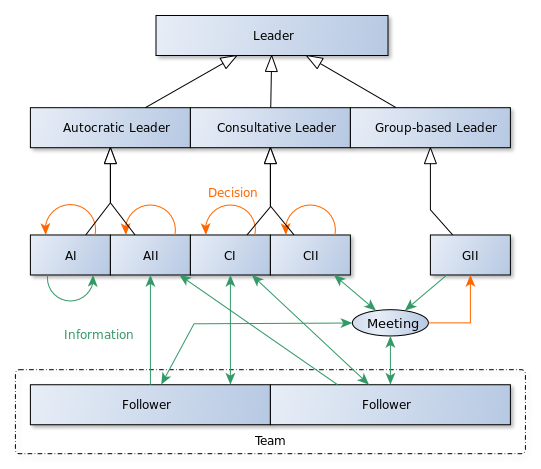
The choice of decision process depends on seven situational characteristics:
- SC1. The importance of the quality of the decision.
- SC2. How much of the necessary information the decision maker has.
- SC3. How structured the problem is.
- SC4. The importance of acceptance by subordinates.
- SC5. The likelihood that an autocratic decision will be accepted.
- SC6. The subordinates’ motivation to attain organizational goals.
- SC7. Disagreement among subordinates over the solutions.
This model has drawn some criticism because it considers only certain aspects of leader behavior (R. H. G. Field, “A Critique of the Vroom-Yetton Contingency Model of Leadership Behavior”, Academy of Management Review, 1979), and so lacks an overall view.
The large number of models, approaches and theories about decisions shows how important it is to work out the right approach for each problem and each decision maker.
(Alberto Viotto)